The room you sleep in is the one place on a trip where you're most vulnerable. You're unconscious for a third of your time there. Your possessions are concentrated there. Your exit options are limited and often unfamiliar. And yet, almost no traveller spends more than 90 seconds checking that the room is actually safe.
The 60-second routine below is what experienced travellers – frequent business flyers, journalists, security professionals – run on every single check-in. It catches the small number of cases where something is genuinely wrong before they become the cases that make the news.
The 60-second arrival routine
When you walk into the room for the first time, before you unpack, do these five things:
1. Locate two exits. The door you came in, and the nearest fire exit. Walk to the fire exit and physically check that it opens, and that the corridor is clear. In a fire, in smoke, at 3am, you will not have time to figure this out. Doing it once on arrival means you can do it on autopilot when it counts.
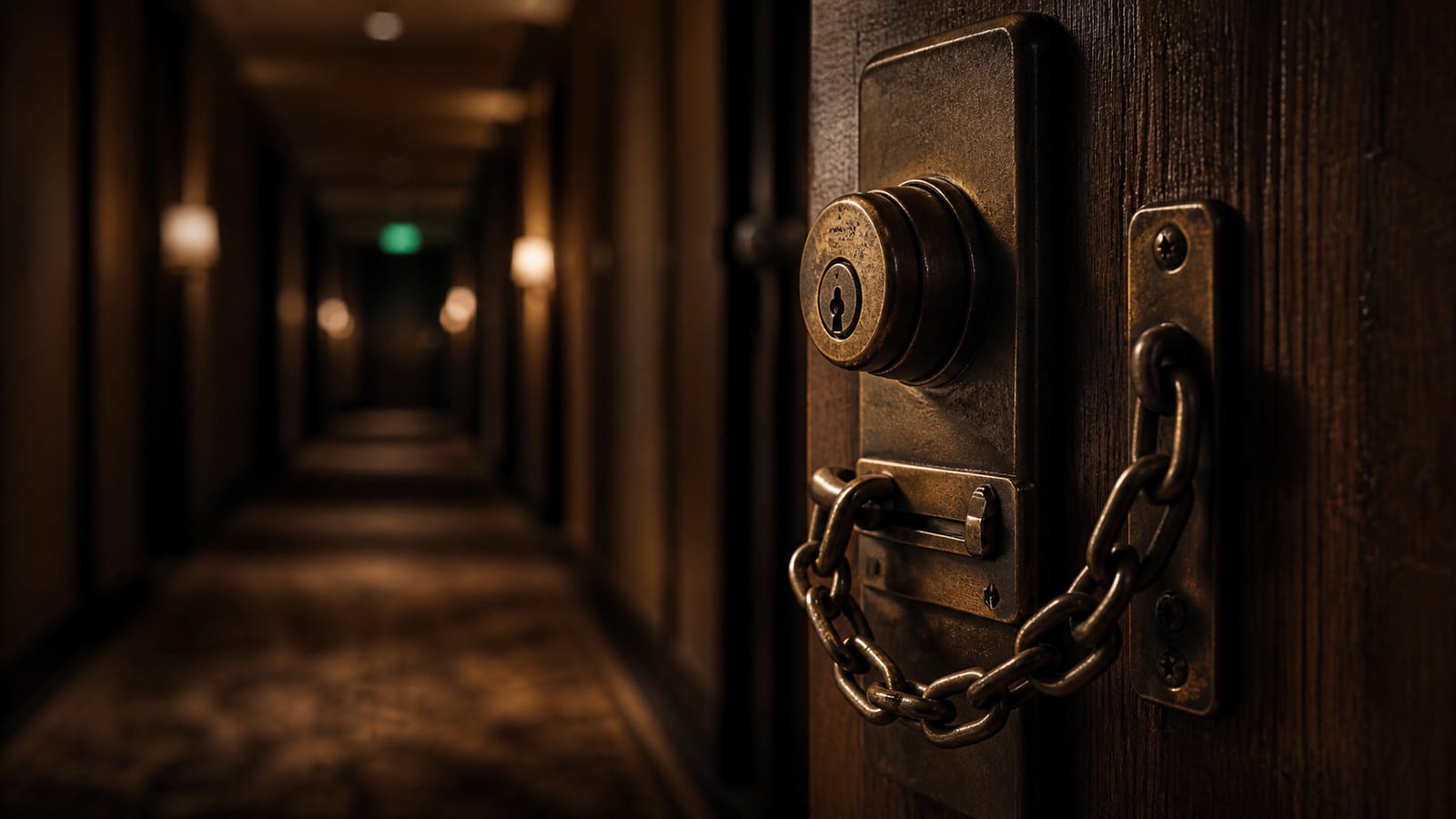
2. Test the locks. Door deadbolt, chain or swing latch, and any window locks. If anything doesn't work, ask reception for a different room. They will move you. Don't sleep behind a broken lock.
3. Check the room for things that shouldn't be there. Look in the wardrobe, behind the curtains, under the bed, and in the bathroom. This sounds paranoid; it takes 20 seconds and has saved a non-zero number of travellers from people who hadn't yet checked out.
4. Identify the room number and the floor on autopilot. If you need to call emergency services from the room, you'll need to give them this information immediately. Most travellers freeze up. Knowing it cold means you don't.
5. Set up your portable door lock. A £10–15 device that wedges under the door or attaches to the strike plate. It defeats almost every form of forced or surreptitious entry. Pack it. Use it every night.
This entire routine takes about a minute. Done consistently, it eliminates most of the situations that catch travellers out.
Fire safety: the one risk most travellers ignore
Hotel fires are rare but they kill more travellers than almost any other accommodation incident. The factors that turn a survivable fire into a fatal one are almost always the same: travellers who don't know where the exits are, who try to use lifts, or who can't navigate smoke-filled corridors.
The fixes are simple. Always request a room between the second and sixth floors – high enough that ground-floor break-ins are harder, low enough that fire ladders can reach you. Never use lifts during a fire alarm. If smoke is in the corridor, stay low and move along the wall toward the exit. If you can't leave, fill the bath with water, soak towels for the door gaps, and signal from the window.
Most hotels run their fire safety to a standard. Short-term rentals frequently don't. In any short-term rental, identify the smoke alarm, test it if you can, and locate the fire extinguisher and the second exit before you go to sleep on your first night.
Hidden cameras: the rising risk in short-term rentals
The number of confirmed hidden camera cases in Airbnb-style rentals has risen sharply since 2020. Some are the work of property owners; some are the work of previous guests who installed and left them. Either way, the risk is real, and the detection is straightforward.
The 30-second sweep:
- Look for IR LED dots in dark rooms. Turn off the lights and slowly scan the room with your phone's camera. Many hidden cameras have infrared LEDs that show up as small purple or red dots through a phone screen.
- Inspect anything pointing at the bed, the shower, or the toilet. Smoke detectors, clock radios, decorative items, mirrors, electrical outlets, chargers left plugged in, picture frames. These are the most common hiding spots.
- Check Wi-Fi networks on arrival. A hidden IP camera will often broadcast its presence. Apps like Fing scan local networks and flag unfamiliar devices.
- Look at mirrors carefully. Two-way mirrors used to be a niche concern; they're not anymore. Press a fingertip to the glass – if the reflection touches your fingertip directly with no gap, it's likely a two-way.
For frequent travellers, a £20 RF detector adds another layer and pays for itself the first time it finds something.
If you find a camera: photograph it, document its position, leave the property immediately, report to the platform (Airbnb takes this seriously and will refund and ban the host), and report to local police. Don't disable it – leave it for the investigation.
Short-term rental specifics
Short-term rentals trade hotel-grade security for space and price. The trade is often worth making, but the safety calculus is different.
Things to check before you book: the host's review history (not just the property's), specific mentions of safety in reviews, the listing photos against the actual address (Google Street View), and whether the host responds quickly to messages. A property with 50+ reviews and a host who answers within an hour is a meaningfully different risk profile from a brand-new listing with a slow host.
Things to check on arrival: smoke alarms, carbon monoxide alarms (essential for rentals with gas appliances – a £15 portable CO alarm is one of the highest-value pieces of travel kit you can carry), the locks on every door, the windows, and any ground-floor access points.
Things to do during the stay: don't post the address on social media, lock everything when you leave, don't accept deliveries you didn't order, and trust the instinct that says "something is off" – Airbnb support will often relocate you, and good hosts will refund you.
The principle
Hotel and rental safety is one of the few areas where 60 seconds of effort genuinely matters. Most rooms are fine. A small percentage have problems you can identify in under a minute with the routine above. Doing it every time means you never have to wonder which room you're in.
Sleep is when you're least able to defend yourself. The minute you spend on arrival is what lets you sleep without thinking about it.