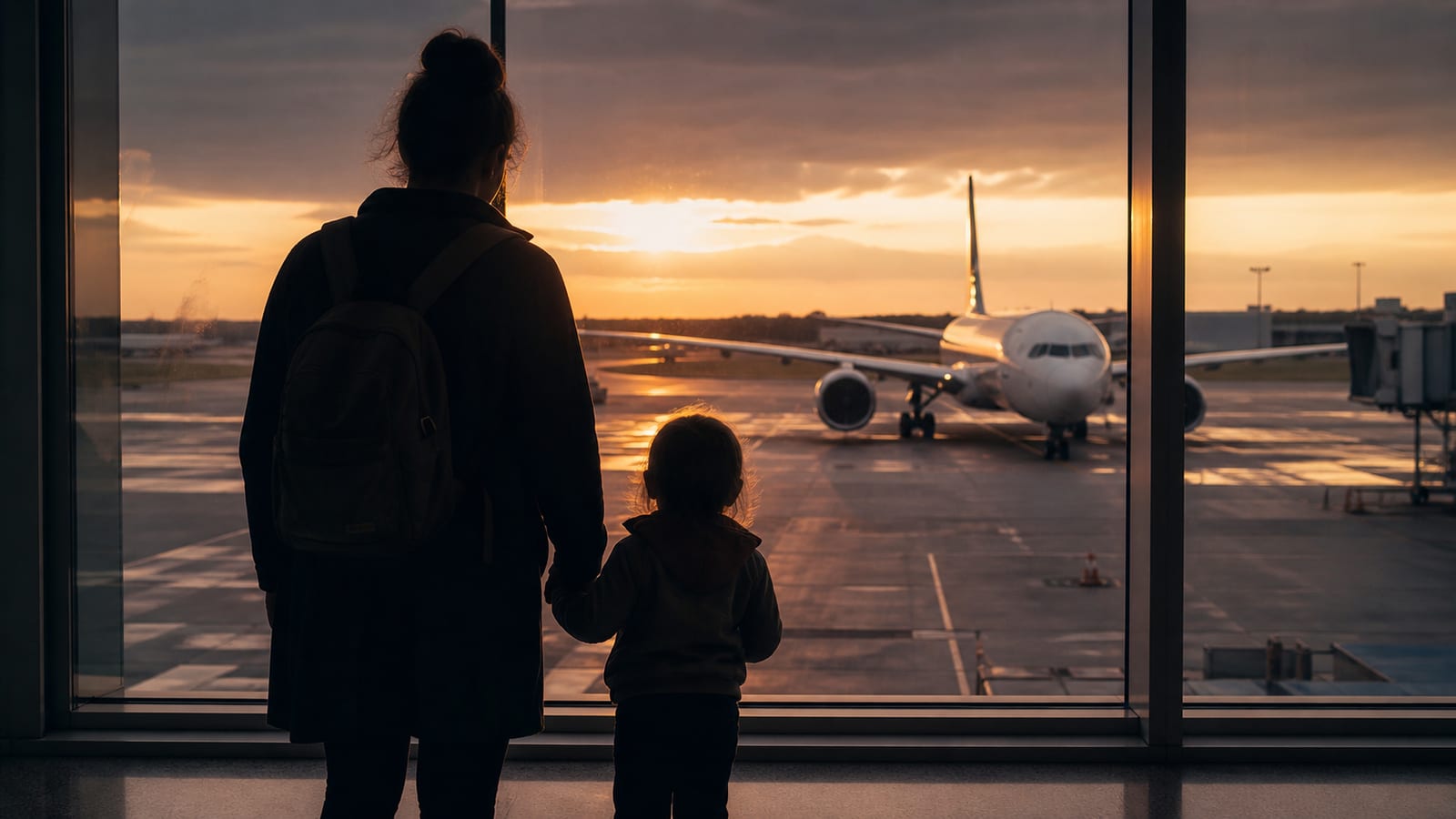
Travelling with young children doesn't make travel more dangerous, but it does change the risk calculus. The things that might inconvenience an adult traveller – a stomach bug, a missing bag, a long delay, a wandering moment in a crowd – escalate faster and matter more when there are children involved. The preparation that handles this is mostly small, mostly cheap, and mostly the kind of thing parents do for their first trip and then keep doing forever.
Here are the 12 things that matter most.
1. Have a lost-child plan, agreed before you leave home
The single most important item on this list. Decide in advance: if a child gets separated from you in a busy place, what do they do, and what do you do? The standard plan: the child stays exactly where they are, and you come back to find them. It works because children panic and move faster than parents can search.
Teach children old enough to understand: stop, stay, look for a "safe stranger" (a parent with their own kids, a uniformed staff member, a person behind a counter). Drill it before the trip – at home, in the supermarket. The drill is the difference between a five-minute reunion and a much worse afternoon.
2. Take a recent photo every morning of the trip
A photo of your child wearing what they're wearing that day, taken on your phone every morning. If they go missing, you can hand the photo to anyone helping the search. "She's wearing a yellow t-shirt and blue shoes" is dramatically more useful than "she's about three feet tall". Costs five seconds. Has saved an enormous number of trips.
3. Write your phone number on the inside of their clothes
Or on a temporary tattoo, or on a card in their pocket. For pre-verbal children especially. The number gets used roughly never. Until it gets used once.
4. Pack a serious medical kit, not a kid-sized one
Children get sick faster, dehydrate faster, and develop fevers more dramatically than adults. The kit needs: paracetamol and ibuprofen in age-appropriate liquid form, an oral syringe (medicine spoons are imprecise and pharmacies abroad may not stock them), oral rehydration salts (children with stomach bugs are at real risk of dehydration within hours), a thermometer, antihistamine, plasters, antiseptic, and any prescription medication doubled.
Don't assume foreign pharmacies will stock what you need at 2am. They often don't, and the brand names are different even when they do.
5. Get the documentation right before you leave
Children's passports often have shorter validity windows than adults', and many countries require six months' validity on arrival regardless of the bearer's age. Check this two months before travel, not two days.
If you're travelling without the child's other parent, many countries – increasingly – require a notarised consent letter from the absent parent. South Africa is famously strict about this. The cost of getting it wrong is being denied boarding.
6. Choose accommodation with children in mind
The questions that matter: what floor is the room on (anything above the second is harder to evacuate with small children); are there balconies (and if so, are the railings child-safe); is there a kettle on a low surface (the single most common hotel injury for toddlers is scalding); is there a pool, and is it gated.
A half-star drop in hotel rating is almost always worth it for a property that takes child safety seriously. Look for "family-friendly" in reviews specifically – what tour operators call family-friendly and what other parents call family-friendly are often different things.
7. Bring your own car seat (or rent one from a serious provider)
Rental car companies abroad often provide car seats that are old, dirty, missing parts, or installed incorrectly. The fix is either to bring your own (most airlines fly car seats free as checked baggage) or to rent from a company that specifically handles child equipment to UK/EU/US standards. Don't assume; ask before you book.
8. Plan for sun, water, and altitude separately
Children burn faster, dehydrate faster, and adjust to altitude more slowly than adults. The interventions are simple: sun cream applied every two hours and reapplied after swimming, water bottles refilled constantly, and a slower first day or two at any altitude over 2,000 metres. The mistake parents make is treating these as adult-style concerns scaled down. They aren't – they're genuinely different in degree.
9. Know where the hospital is before you need it
For every destination, before you arrive: identify the nearest hospital with paediatric care, the route to it from your accommodation, and the local emergency number. Save the hospital's address in your offline maps. The five minutes spent doing this is the highest-value preparation a parent can do, and almost no parent does it.
10. Get the right travel insurance
Family travel insurance is a different product from individual travel insurance. The things to check: are the children genuinely covered (some policies cap children's medical cover at lower amounts), does the policy cover paediatric repatriation if needed, and does it cover one parent flying home alone with a sick child while the other stays with luggage / siblings.
The cheap policy is rarely the right one for families. The right one is usually 30–40% more expensive and meaningfully better in the situations that actually matter.
11. Manage the airport, not the destination
The riskiest part of family travel is the journey itself, not the destination. Airports are crowded, fast-moving, and full of distractions. The disciplines: hold hands or use a wrist link in transit areas, designate one parent as "child-watcher" while the other handles bags, use family lanes at security, and accept that boarding will be slower with kids than without.
12. Set up a real-time alert service that includes the family
If something happens in the country you're visiting – a terror incident, a natural disaster, a sudden political situation – you don't want to be the parent finding out from social media while pushing a stroller through a market. Real-time alert services push incident notifications fast enough to act on, and increasingly let multiple family members see the same alerts. The peace-of-mind value when you have small children with you is hard to overstate.
The principle for family travel
The advice for travelling with children is mostly the advice for travelling without children, applied earlier and more consistently. Plan more, pack better, move slower, choose accommodation more carefully, and build in margin everywhere.
The parents who do this rarely have horror stories about family travel. They just have stories about the trip.